Showing posts with label sepia saturday. Show all posts

Thursday, March 17, 2011

i was a swashbuckler

Isn't it amazing how a tune can evoke a specific event in time? Woody Allen includes the best music in his films. Last weekend, I watched Scoop, and a piece of movie music carried me straight back to my childhood. My uncles, actually more like brothers in age, and I used to sword fight to Aram Khachaturian's Sabre Dance. We would play the piece from an LP record on a turntable, volume cranked to the max.

When the music ended, we moved the needle back and played it over until we were completely clashed out. Don't worry, we didn't use actual swords. Curtain rods were the next best thing, thrilling crash of metal on metal, imaginary sparks flying, catching the room on fire. I miss my Joan of Arc days, swashbuckling with the best of them. I should take fencing lessons.

By the way, the Khachaturian is deliciously quirky music. I think I will have it played at my funeral.


our Ben-Hur production still, 1959

We were an incredibly theatrical household. The saber dances are tucked safely away in my mind's eye, but I wish I had a tangible photo. I do have a shot of one of our Ben-Hur-esque dramatic productions. This wasn't just for fun; we were dead serious players. Speaking of serious, I was rather a precocious child. Here I am below, busy with some very serious writing, maybe an epic screenplay or some poetry. Nothing has changed.

This is a Sepia Saturday post.

Saturday, October 2, 2010

limelight


for Sarah Dunnam Lewis, 1855-1924


This lamp is a woman.
The chimney's seductive curve,
the floral lip, its symmetry is yours.
You sponged black soot,
replaced the wick, like walking
tightrope in your sleep.

Brood brought down the house,
but never you, never the lamp.
She faired a sideshow century
without a chip, crated-up
in steam engines and horse carts,
Burnt Corn to New Mexico,

till a deep-snow Hoosier night,
the undertaker raised her
over your face,
for one last applause.
He did not grope
the hand-painted porcelain,
but balanced her in his palm,
like a juggler.


Tess Kincaid
October 2, 2010


To join Magpie Tales creative writing group, click HERE.
This is also a Sepia Saturday post.

Saturday, August 28, 2010

happy accident

I was on a mission to find something in particular this week at the manor, and as is usually the case, I didn't find what I embarked on, but something else, instead. These things fall into the "happy accident" category, along with fantastically blurred photos, and genius freak goofs in recipes. You know, one of those fun synchronicitous turn of events. So, what happy accident did I happen to stumble upon? A misplaced box of keepsakes and photos, now mellow with time.

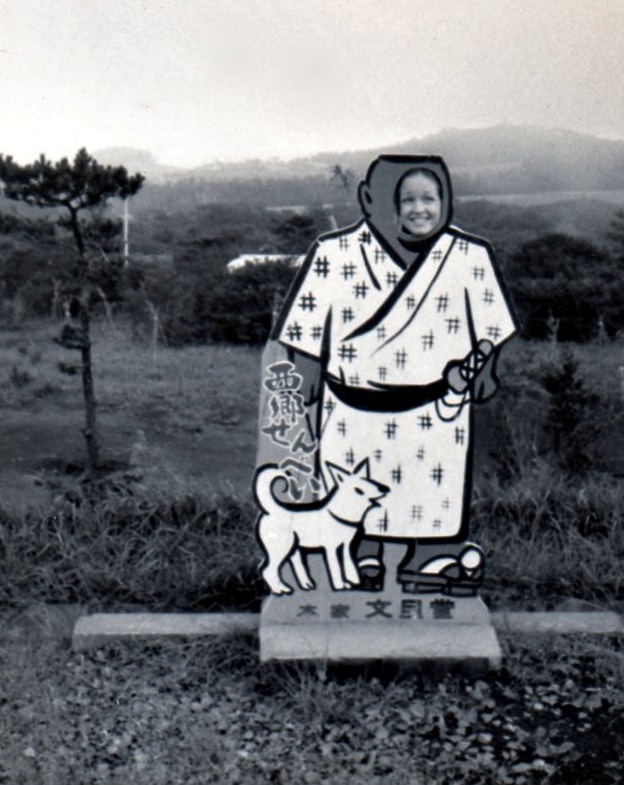
me July 1973
It was the summer before I turned 17. This little Midwestern girl took off on the first big adventure of her life, spending the summer with friends in lovely, exotic Kagoshima, Japan. The city is situated across the bay from Sakurajima, an active volcano, which daily spews ash on the surrounding area. One of the things I remember most profoundly, was waking each morning to a hair-full of volcanic grit. The most violent volcanic explosion was in 1914, in which the lava flows caused the former island of Sakurajima to be connected to the Osumi peninsula.

I didn't own a camera of my own then, or I would have had a delightful photographic diary of my adventures. I did, however, stumble onto a few photos taken by my friends. In addition to a daily swim in the East China Sea, we spent a lot of time crammed into Japanese railway cars. I was even, on one memorable occasion, mistaken for the current heart-throb Olivia Hussey. That guy will never know his little error did wonders for my self-esteem. I'm still talking about it 37 years later.

me in my yakuta


In all seriousness, in addition to giving me a life-long love of all things Japanese, spending some time early on in another culture instilled a sense of acceptance, gained in few other ways, but to live in and among a society that is different from one's own. It also gave me an early appreciation for my own country and it's privileges. It's good to walk a mile in another 's shoes, or zori, as the case may be.

“Prejudices, it is well known, are most difficult to eradicate from the heart whose soil has never been loosened or fertilized by education; they grow there, firm as weeds among stones.” Charlotte Bronte
packed in a train like sushi
(don't you love the knee-socks?)

...and catching a few winks

This is a Sepia Saturday post.

Friday, June 11, 2010

the yearling makes my dna tingle

James Dunnam home, near Brewton, Escambia Co., AL, circa 1900
(click to enlarge)
The Yearling, N. C. Wyeth

Sunday night I watched the wonderful 1946 film adaptation of Marjorie Kinnan Rawlings' The Yearling, the story of a rebel soldier and his wife, who after the Civil War, become pioneer farmers in Florida. Every time I see it, I am reminded of my great-great-great-grandparents, James Alexander Dunnam and his wife Sina Isabelle Morris, who farmed near Brewton, Escambia County, Alabama, near the Florida border, just after the Civil War. They raised nine children in this house, that looks so much like the one in the movie. I often wonder what similar hardships they suffered, and what "Old Slewfoot" stories they might have to tell. My great-grandmother, Ida Belle Lewis, is the little girl sitting on the left of the front steps, with her hand raised to shield her eyes from the sun. Notice the portrait of the Dunnam's deceased son, Enoch, her uncle, placed outside on the porch, as part of the family photo.

James Alexander Dunnam and Sina Isabelle Morris Dunnam, circa 1900


Saturday, May 29, 2010

mockingbird


for Mary Hopkins Hanna


I first took note, when you came to me
with that song about the mocking bird,
how it sings o'er Hally's grave.

You know the bird well.
Watching your brave poppa
return to the valley that dull day,
boxed in Confederate pine.

You heard it sing again
when you climbed on the wagon
headed west, pulling the little goat behind,
and held the hand of your widowed ma;
family split amongst Hoosier kin, forsaken.

You remember the bird, at its very worst,
as you stood at the open grave of a son,
the same age your poppa was.

Saddest song you'd ever heard,
mocking curse of that damn bird.


willow, 2010


Name: Bennett H. Hopkins
Residence: Franklin County, Virginia
Occupation: Carpenter
Enlistment Date: 24 May 1862
Distinguished Service: DISTINGUISHED SERVICE
Side Served: Confederacy
State Served: Virginia
Unit Numbers: 819 819
Service Record: Enlisted as a Private 24 May 1862 at the age of 31
in Company D, 58th Infantry Regiment Virginia, 24 May 1862.
Died of disease Company D, 58th Infantry Regiment Virginia, 09 February 1864


Bennett Hopkins was my great-great-great grandfather. One day, several years ago, I spent an afternoon logging genealogical stats of his youngest daughter, Mary, my great-great grandmother. I wondered about her thoughts and emotions, having lost not only her father to an untimely death, but also her handsome son, Guy. That evening, as I cooked dinner, I found myself humming a peculiar tune over the stove. I couldn't get the odd song out of my head all week. After some searching, I found it was Listen to the Mockingbird, an American folk song popular during the Civil War. It was said to be Lincoln's favorite song. I believe it also happened to be Mary's. (click here for my post on Deep DNA)


Saturday, May 22, 2010

cardomania

This week, my dear bloggy friend Alan, over at News From Nowhere, mentioned finding a lovely carte de viste on a recent trip to an antique fair. As synchronicity would have it, I also found a lovely CDV while browsing in a local antique shop last month. This lovely young lady whispered my name, from a dusty box of vintage ephemera, atop an old filing cabinet. I paid $2, popped her in my handbag and whisked her off to the manor.

Carte de viste, or CDV, is a small victorian photo made of an albumen print, a thin paper photograph, mounted on a thicker card. They are usually 2 1/2 x 4 inches, about the size of a calling card. "Cardomania" became enormously popular beginning in about 1860 in the United States, and the photo cards were traded wildly among friends and visitors. By 1870, carte de vistes were replaced by the larger cabinet card photos, 4 1/2 x 6 1/2 inches, which remained popular until the arrival of the Brownie camera and home photography snapshots became the rage.

Something about this young woman in the photo drew me to her. She reminds me of Winona Ryder in the role of May Welland in Scorsese's film version of Edith Wharton's The Age of Innocence, so fresh and full of hope. I wonder if the twisted pearl choker was a gift from a special someone?

After I bring a vintage treasure home, part of the thrill is doing a bit of detective work. As you can see from the reverse of the card, the photo was taken by Urlin Photographer, 216 and 218 South High Street, Columbus, Ohio. G. C. Urlin was a prominent local photographer in the late 19th century, with a gallery located in downtown Columbus. I located a similar photo taken in 1895 by Urlin of Lulu Billheimer Wright, married to Reuchlin Wright, brother of the famous Wright brothers, as part of the Wright Brothers Collection, Wright State University. I also took a little trip to 216 S. High via Google Earth and found the original spot has now been replaced by a high rise building, which was actually no surprise.

I hate to see charming vintage photographs separated from their families, tucked away in lonely stacks in flea markets and shops. I'm often known to pick up those with which I feel a certain connection. You might remember the great framed photo of this little guy I adopted last year from the Heart of Ohio Antique Mall. He has an uncanny resemblance to my youngest son, and feels right at home at Willow Manor.

This is a Sepia Saturday post.

Saturday, May 15, 2010

fifth street


for Anna Rathfon Nichols, 1882-1938


They declared their chips in Kansas.
Ace came round in a new fangled motor,
wore a fancy suit. She flew to him like a railbird.

Free hand wrangler, he scooped her up,
built his deck with brick and mortar.
He bought the pot; she bought short.

Mother and sister packed their lot,
headed north, after the fire that killed her pa.

Dealt a dead hand, he lost his Oklahoma purse.
After two stillborn births, this wild card shark
proved his bluff and upped the ante.

Go back to Indianny and console your ma.
I'll be up to collect you directly; he slipped
out the back door on a chronic rabbit hunt.

Cursed rag left her in the dark,
blind to his habit, crippled by a silent flush,
a gypsy muck of syphilis and insanity.


willow, 2010


Ace and Anna, Galena, Kansas, 1910

The story of Ace Nichols never returning to Indiana for my great-aunt Anna, has always been a sad part of my family history, but after I obtained her medical records, the story became even more tragic. Since his name happened to be Ace, I couldn't resist throwing in all the poker terminology.


This is a Sepia Saturday post.

Saturday, May 8, 2010

charming gardeners


Let us be grateful to people
who make us happy,
they are the charming gardeners
who make our souls blossom.

Marcel Proust


If I had a single flower for every time I think about you,
I could walk forever in my garden. ~Claudia Ghandi

My little gardeners and me, November 4, 1986

Saturday, May 1, 2010

...all the live long day


This is one of my paternal great-grandfathers, Glen Pullen, 1891-1950. I never knew him, since he passed away six years before I was born. He was married to [Emma Mae Rathfon], who sadly was admitted to Central State Hospital, Indianapolis, shortly after the birth of their first child, my grandmother, Alice, for the duration of her life.

I love the photo, below, of Glen working as part of a railroad section gang, complete with spike drivers and shovels, in Flora, Indiana in 1923. Section crews, or section gangs, as they were commonly known, were responsible for the maintenance of a large section of track. They typically rode handcars to replace bad ties, tamp loose spikes and tighten bolts.

CLICK TO ENLARGE
Glen Pullen, (center) Railroad Section Gang 19,
April 26, 1923, Flora, Indiana

I wonder if Glen and his gang ever sang the American folk song, "I've Been Working on the Railroad"? The first published version appeared as "Levee Song" in Carmina Princetonia, a book of Princeton University songs published in 1894. The earliest known recording is by the Sandhills Sixteen, released by Victor Records in 1927.

The "Someone's in the kitchen with Dinah" part is actually an older song that has been absorbed by "I've Been Working on the Railroad". It was published as "Old Joe, or Somebody in the House with Dinah" in London in the 1830s, with music credited to J.H. Cave. "Dinah" was a generic name for an enslaved African woman. The melody for this section of the song may have been adapted from "Good Night Ladies", written (as "Farewell Ladies") in 1847 by E. P. Christy.


We all know the original words, but you may not know this verse, printed in The Family Car Songbook, by Tam Mossman. This particular version sounds like that of a real section crew, not "just to pass the time away". I bet if Glen and the guys were singing, it would have been this no-nonsense version:

I've been workin' on the trestle,
Drivin' spikes that grip.
I've been workin' on the trestle,
To be sure the ties won't slip.
Can't you hear the engine comin'?
Run to the stanchion of the bridge!
Can't you see the big black smokestack
Comin' down the ridge?


This is a Sepia Saturday post.

Saturday, April 24, 2010

conquering the west with beef steak and a cup of coffee

Henry and Neva Hanna Crownover, circa 1910
Harvey Girl uniform

Uncle Henry and Aunt Neva were packed and ready to leave their home in Decatur, Indiana and head into the wild west to visit her parents, Palestine and Mary Hanna, who were living in Albuquerque at the time. I adore their smart travel attire. Neva's wool houndstooth skirt, with matching coat, over one arm, complete with pocketbook, gloves and hat. Uncle Henry looks mighty dapper, himself, in his summer straw hat, and collar perfectly held in place with studs, and a lovely silk tie.

I heard a fascinating piece on NPR this week about Fred Harvey, responsible for bringing good food at reasonable prices in clean, elegant restaurants, to the travelling public throughout the Southwest in the late 1800s and early 1900s. They were well known for their great steaks, coffee, and excellent service. By its peak in 1928, the Fred Harvey empire ran nearly 100 restaurants and 25 hotels from Chicago to Los Angeles.
Harvey Girls Maryellen Harris Skillman*,
right, and friend

No doubt, Uncle Henry and Aunt Neva would stop somewhere along the way, at least once, at a Fred Harvey railroad eating house. The train would stop just long enough for hungry passengers to order a blue plate special, a sumptuous meal, served on china with a blue pattern. Men patrons were even required to wear a jacket and tie in order to be served. Uncle Henry would definitely pass inspection.

Harvey Houses were famous for their excellent service, provided by their staff of Harvey Girls. Fred Harvey sought out single, well mannered, educated ladies, and placed ads in newspapers throughout the east coast and midwest for "Young women, 18 to 30 years of age, of good character, attractive and intelligent." It's estimated that 100,000 women went west to work as Harvey Girls.

Today, the Harvey Girls are most likely known from the 1946 MGM musical The Harvey Girls, in which Judy Garland plays a young woman heading west, as a mail order bride, but ends up joining the Harvey Girls, instead.The hit song from the film "On the Atchison, Topeka and the Santa Fe", won an Academy Award for Best Original Song for Harry Warren and Johnny Mercer.

In this movie, it was said that the women were "conquering the West with a beef steak and a cup of coffee". Sounds pretty good to me.


This is a Sepia Saturday post.


*Thanks to Sheri Fendley for the photo of her grandmother.


Saturday, April 17, 2010

city girl with a country heart

city girl willow's big catch 1972

It's been years since I've gone fishing. I actually love to fish. My grandmother taught me how to bait a hook with a night crawler and cast it into the stillest, darkest, deepest part of the water, under the trees. I only remember fishing once, after moving away from Grandma, at a summer barbecue of my father's work associates. Grandma taught me well, because I ended up catching the largest fish of the day with my little bamboo pole. I guess you could call me a city girl, with a country heart. Although, growing up in various subdivisions across the Midwest, wasn't exactly city, but certainly not the country, either. The American subdivision is a culture all its own. But, I'll save that for another post.

I wish I had a picture of Grandma fishing. Luckily, I do have one, in my mind's eye, contentedly sitting, pole in hand, on her lawn chair on the bank of Wildcat Creek. While browsing pics, I did, however, find this lovely old boating photo of my great-grandmother Ida Belle, with her two sons, Chester (my paternal grandfather), his brother, Uncle Bright, along with the Williams and Rains families. The picture was taken by my great-grandfather, Glenn. (You remember him, from last week's post, posed with his portable bellows camera.) This tiny postage stamp sized photo enlarged quite nicely. I love how everyone is dressed to the nines in dresses, hats, suites and ties. Every outing was a special occasion. I like that.

Ida Belle Hanna, seated center with my grandfather Chester
circa 1921, Howard County, Indiana

For more Sepia Saturday participants click [HERE].

Friday, April 9, 2010

move over annie oakley

Ida Belle Lewis Hanna, Albuquerque, 1913
I love this portrait of my paternal great-grandmother, Ida Belle Lewis Hanna. It was taken in about 1913, shortly after her marriage to Glenn Hanna. I love her Oakleyesque pose on the rocks outside Albuquerque, New Mexico, complete with her leather skirt, holster, pistol, bullet belt and just a peep of petticoat.

Both Ida's father, Joseph Thomas Lewis, and Glenn's brother, Guy L. Hanna, were ill with tuberculosis, and the families had relocated to New Mexico for the benefits of the climate. The Lewis family was from Escambia County, Alabama and the Hannas from Howard County, Indiana.

Glenn Hanna and his delivery wagon for J.C. Boyd Grocer, circa 1912
I fondly remember my great-grandma telling me how she met Glenn, a delivery man for J. C. Boyd, Grocer in Albuquerque, behind a huge hanging bunch of bananas in the store. They were married March 19, 1913 in New Mexico, and returned to farm in Howard County, Indiana, after it was sadly determined that Glenn's brother, Guy, would not recover from TB.

As Alan mentioned this week, if it weren't for avid enthusiasts, like my great-grandfather, who invested in the art of photography, we would not have these wonderful treasures, these unique bits of history, family legacy, and art. We owe them a great debt of gratitude.

Glenn with his portable bellows camera, circa 1913

This is a Sepia Saturday post.

Saturday, March 27, 2010

my groucho marx


Monday was my paternal grandfather, Chester Hanna's birthday. He passed away in May of 2007 at the ripe old age of 93. He was surprisingly computer savvy for a man of his generation. I miss his daily emails. They weren't terribly newsy, but he fondly called me "kid", and it always brightened my day to see one of his messages waiting in my inbox. He handed down his love of genealogical research to me, and we spent many afternoons online, sharing family history.


He was born in Ervin Township, Howard County, Indiana on March 22, 1914, and lived in and around the area his entire life. He retired after working for Delco Electronics for 35 years, but always had a bit of an entrepreneurial spirit, dabbling in various businesses. For years, he ran a professional photography studio from his home, with a complete dark room in the cellar. I spent many a happy hour watching the photos magically emerge in the pans of fluid. To this day, I think of him whenever I walk into a photo shop, and catch that heavenly whiff of developing solution.


One of my dearest memories is standing in the back of his easy chair and asking for his black plastic comb, which he always kept, along with his assortment of pens in his trusty pocket protector. After I combed his Brylcreemed hair down over his eyes, he would peer out with a comical look, and make me giggle with delight. He was a quiet and unassuming little man. I always thought if he would just grow a thick mustache, and smoke a cigar, he would look exactly like Groucho Marx. But his personality was totally different; no singing of Lydia the Tattooed Lady, or silly Grouchoesque walks. And that's okay. I loved him just the way he was.


For more Sepia Saturday posts, click [HERE].

Saturday, March 20, 2010

retail & railroad romance

With the passing of WT's mother this week, I've been thinking a lot about her family. Her maternal grandfather, William Isaac Cummins, owned and operated a general store in Kansas City. This photo, taken in about 1905, shows her mother, Ruth Cleveland Cummins, the young girl in the center in the dark dress, her parents William and Addie Cummins to the left, and her older sister and brother in law on the right.

WT likes to wear a big apron, just like his great-grandfather did, when he cleans up in the kitchen. It's surprising how much he favors him, in appearance, especially with the apron.

As the story goes, the store was located near the railroad stop, and Grandma Ruth met the dashing young railroad engineer, Ralph McIntire, one afternoon, as he sauntered into her father's store, on one of his frequent Kansas City stops. They chose a Christmas Eve wedding, marrying on December 24, 1916.
.
.

Saturday, March 13, 2010

my lady liberty


In my early childhood, I spent many idyllic days with my paternal
grandmother. The things that inspire me most, I can trace back to
this dear woman. For instance, my uncles tell me that I've inherited
her ability to artistically arrange things, like tablescapes. I have to
be careful not to turn every surface in the manor into some sort of
dramatic scene. I have fond memories of tagging along with her, to
an empty church on a Saturday afternoon, and watching her arrange
a beautiful altarscape. She used fresh flower cuttings from her
garden, rich fabrics, and an assortment of odd antiques for her
unique creations.
.
Speaking of flowers, I've also inherited her green thumb. Grandma
adored plants of all kinds. Local people would drive around her
corner lot, in the rural Indiana village of Burlington, extra slowly, just
to admire her glorious flowers, little fish pond, and fountain. One of
my favorite memories is helping her gather dandelion greens along
cornfield lined country roads. She taught me how to do essential life
tasks, like how to bait a fishhook with a nightcrawler at Wildcat
Creek.
Lazy afternoons, I sat by her side, as she peeled mountains of apples
for homemade pies. She wouldn't make just one. Her kitchen became
a pie factory, baking six or eight at a time. The charming fern pattern,
I watched her make in the crusts, with the tip of a teaspoon, I still use
to decorate my pies today. While the pies were cooling, I would
snuggle on her lap and listen to generous portions of the delightful
Hoosier poet, James Whitcomb Riley.
.
Even though she could play the piano beautifully, she rarely did, but
insisted her children, my aunt and uncles, practice daily, with much
chiding and an occasional slap with the fly swatter. All the classics,
along with Chopsticks, of course, were indelibly embedded in my
little head. A daily dose of classical music is a must for me, to
chase the cobwebs away, and feel a sense of balance.
.
A year or two ago, I was randomly obsessed with Boris Pasternak
and all things Russian. I reread Doctor Zhivago, and bought both the
Lean, 1969 version and the HBO, 2002 series. When I mentioned
this to my uncle, he said it happened to be Grandma's favorite
movie, that she was crazy about Lara's Theme, and even had a little
music box that played the song. "Oh, I didn't know." I said, DNA
tingling. She would get such a kick out of my Zhivago hat. I can see
her smiling, and trying it on for size.
.
So, what, you're wondering, does the Statue of Liberty have to do
with this post? For me, Grandma's striking features favored those of
Lady Liberty's, and the souvenir statue she kept on her roll top desk.
Sadly, she died three days after her 56th birthday, when I was just
13. I regret she never knew the woman I grew to become, and was
not around to enjoy my lovely family. She will, however, always be
my Lady Liberty, lifting her symbolic ancestral lamp, giving me the
freedom and insight to embrace all she inspired in me.

This is a Sepia Saturday post.

Saturday, March 6, 2010

lincoln's doppelgänger

A grand set of mounted Longhorn steer horns hung in his bedroom, over his bureau. It was an awesome sight to a small girl, peering up from underneath. They belonged to my great-grandfather, Glenn, son of Palestine Hanna, featured here on past Sepia Saturdays, and were from his days in Albuquerque in the early 20th century. Across the top of the horns rested a stately black walking stick, tipped with a silver cap.


Three years ago, after the death of my grandfather, my dear aunt gave me the walking stick I remember so well. After close examination, I barely made out some engraving on the cap. I pulled out my trusty magnifying glass, and played one of my favorite roles, a giddy Sherlock Holmes. Compelled to a delicious hunt, I drooled investigative juices.

Rev. N. Gillam
by
L. H. Hicks
.
As the delicate script appeared from the patina, my DNA danced a little jig. First, I checked my ancestral file, which contains the names and notations of over 6000 people, which I am proud to say, took five long years to log in and document.
.
My fourth great uncle, Oliver Hazard Perry Hanna (1813 -1880), as it turns out, was married to a Rachel Gillam. Sure enough, Rachel had a brother, Nelson Gillam (1814 - 1902) who was minister of the Methodist Episcopal Church near Delphi, Carroll County, Indiana for many years.
.
At the Carroll County Historical Museum's online site, I found a photo of Rev. Gillam. There is a certain compelling, yet haunting, Lincolnesque quality about him, with the same deep set steely blue eyes and gaunt cheek bones. They could be brothers. (I feel another research project coming on.) I was unable to pin down the one who bestowed the gift, H. L. Hicks. I assume he was a dear friend, or possibly a parishioner of his church.
.
Here's what John Rutherford has to say in his book, Millennium History of Carmel Methodist Church:
.
Reverend Nelson Gillam’s ministry here in 1851 and 1852 was not the superficial kind in which numbers are counted, but the kind in which men are gloriously converted to God. His preaching was the type of Peter, filled with power and effectiveness.
.
He must have been quite a charismatic speaker. I would love to take a journey back in time and attend one of his Sunday sermons, his walking stick resting on one of the altar chairs, alongside the pulpit.

Saturday, February 27, 2010

my fondness for stones and bones

I attribute my love of archeology, of relics and bones, to the DNA inherited from my great-great grandfather, Palestine Hanna (1856-1938). Farm folk would bring him bones, and various Native American relics from miles around the tiny village of Burlington, Indiana, for his extensive collection, which he kept in a large,
handmade walnut cabinet.

As a girl, I spent many a blissful afternoon, hands cupped around my eyes, and nose pressed against the glass of that dark, magical cabinet. Literally, hundreds of arrowheads and various relics were part of his vast collection. Sadly, my grandfather sold the entire lot of relics back in the 1960s. A tragic mistake I wish I had been old enough to prevent.

There is, however, one piece from Palestine's cabinet that managed to be saved from the sale. I am fortunate enough to have it hanging in the dining room at the manor. It's a giant 38 inch sawfish blade.I have no idea how or where Grandpa Pal acquired this fascinating item, but I have fond memories of it nestled in the back of his cabinet, keeping watch over arrowheads and spear tips.


For more Sepia Saturday participants, click [HERE].

Saturday, February 20, 2010

sepia saturday, don't take any wooden nickles


Walter, the Missour-ah boy,
who originated the phrase in our family


When I found some loose change in the couch cushions the other
day, it reminded me of a phrase WT likes to say. He got it from his
father, who got it from his father. I guess you could say it is an old
"Missour-ah" boys' saying. The kids used to think it was so funny;
right on par with "I'm going to see a man about a dog", which he
would tell them when he was going somewhere and didn't want to
take them along. I'll save that for another post. I digress. The
phrase in question today is this:

Don't take any wooden nickels.

First recorded in about 1915, this expression was originally a
warning from friends and relatives to country folk in the great
migration from rural areas to the big cities, at the turn of the
century. It was a humorous bit of advice, meaning "beware of
those city slickers". No real wooden nickels were ever
counterfeited. Ironically, the country boys were the ones who
possibly did succeed in passing off wooden objects as the real thing.
Yankee peddlers as early as 1825 allegedly sold wooden nutmegs,
which cost manufacturers a quarter of a cent each, mixed in with
lots of real nutmegs worth four cents each.

A second source says the expression means "don't let yourself be
cheated or ripped off". Originating in the United States, in the 1920s
and 1930s, money that had no real value was sometimes referred
to as "wooden". Stories about wooden nutmegs, wooden hams, and
wooden pumpkin seeds contributed to the later use of the phrase
"wooden nickels" in America, and even the use of wooden rubles in
Russia.

Another source adds that the United States minted five-cent pieces
from the earliest days of the Union, but they were not known as
nickels until 1866, when the first five-cent coins containing nickel
were minted. The practice of making commemorative tokens from
wood as centennial souvenirs developed, and we assume wooden
nickels actually were made during the nineteenth century for this
purpose. Frequently such coins were accepted as legal tender while
the celebration was in progress, but they ceased to have value
when the show was over. So, the expression "don't take any wooden
nickels" became the popular equivalent of "don't be a sucker".

So, hey, there you have it, my bloggy friends.

Have a great weekend, and don't go taking any wooden nickles.


For more Sepia Saturday participants click [HERE].


info from:
The Phrase Finder
Morris Dictionary of Word and Phrase Origins
by William and Mary Morris
Encyclopedia of Word and Phrase Origins by Robert Hendrickson
Random House Dictionary of Popular Proverbs and Sayings by
Gregory Y. Titelman

Saturday, February 13, 2010

sepia saturday, palestine's syrup

This is my Great-Great-Grandfather Palestine Hanna. I have always been intrigued by his unique given name. Census records show only a hand full were named Palestine, both male and female, at the turn of the century. So, it was not particularly a trendy name at the time. Was it biblical, or maybe geographical? I guess I'll never know. I do know, however, that his nickname was "Pal", which I think is so endearing.

The photo below shows Pal tapping into a maple tree on his "Stockwell Farm" in Howard County, Indiana in about 1920. The sap was cooked in a large vat in the woods, in a spot the family called “sugar camp”. It took a whopping 30 gallons of sap to make one gallon of syrup.

Several years ago, a friend of my daughter introduced me to the pleasure of pure maple syrup. After you have tasted the real thing, you can never again eat the icky bottled pancake stuff, we Americans
all know as "syrup". The genuine article is especially delicious wintry mornings, on a nice bowl of steel-cut oats with walnuts and dried cranberries.

For more Sepia Saturday participants click [HERE].