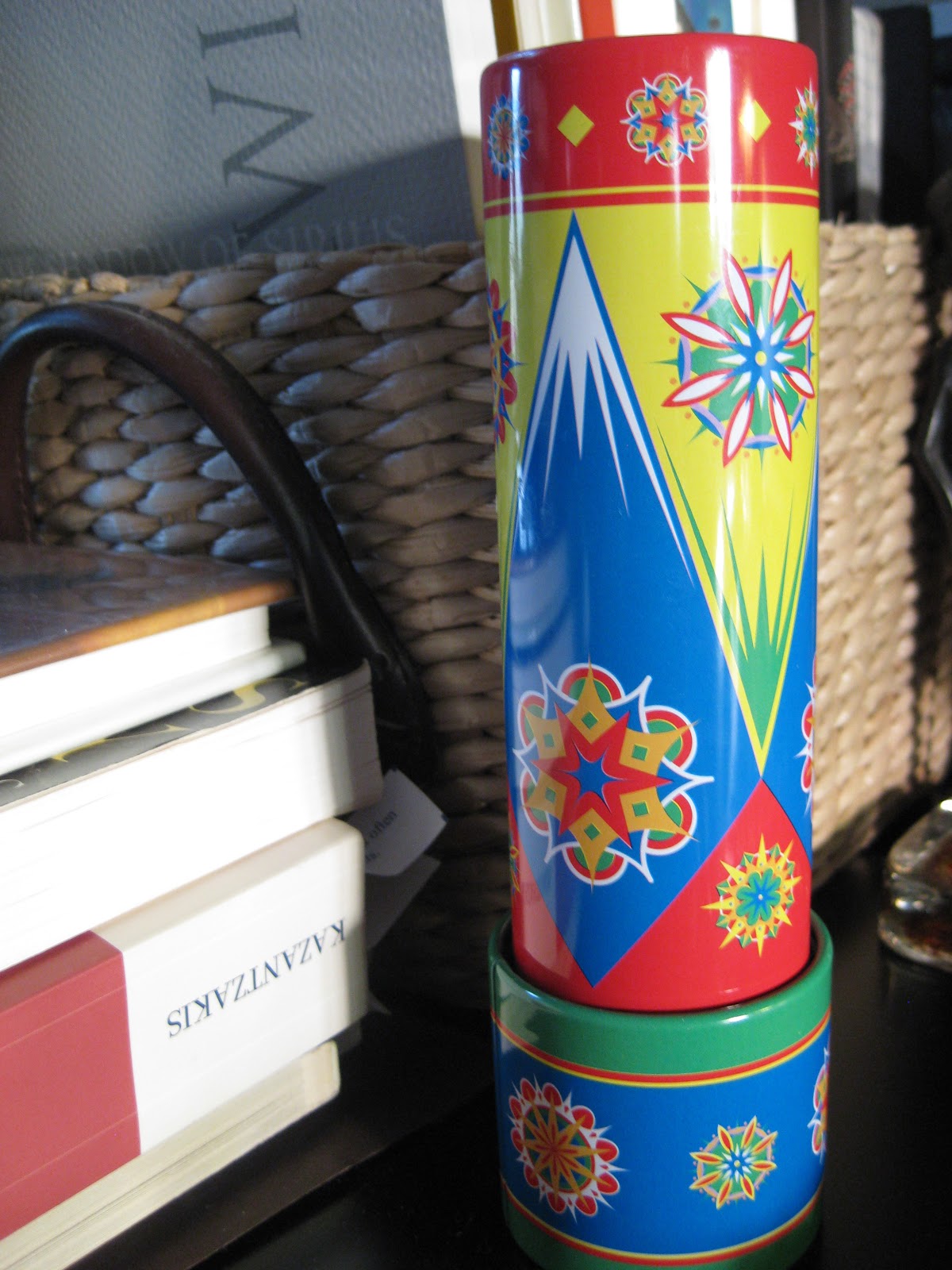
Spring usually hits the Midwest like a hot Mack truck, but this year, I've quite enjoyed the gentle, luscious, foggy-soggy-wet-of-a spring. I spontaneously bought a toy kaleidoscope last week, just like the one I had as a little girl. Spring fever. It must be.
April hath put a spirit of youth in everything. William Shakespeare
Our eyes meet dark
across the kitchen sink,
pooling maternal kinship,
without a lot of fussing
and praying, we regard
a settled melancholy.
Thoughts crisscross
quiet over the dishwater,
with a soothing ritual scrape
of accumulated leftovers,
keeping the best scraps
a sacred Eucharist,
cooled and wrapped
in smooth silence,
to be digested
tomorrow.
Tess Kincaid
April, 2011
Black Madonna image from Wiki
WT gave me a beautiful framed vintage print of the Black Madonna of Częstochowa for Christmas. The galley-style kitchen at the manor has a sink that faces out toward a bit of wall. She hangs, facing the sink, keeping me company as I tidy up the dishes.
There are many theories as to why she is called the Black Madonna, including the dark skin is that of the pre-Christian earth goddesses, the theory that she expresses a feminine power not fully conveyed by a pale-skinned Mary, or that the dark skin is more appropriate in describing the original skin color of the Virgin Mary.
There are those who believe she has some esoteric significance, including being revered by the Templars. I'm quite fascinated by her beautiful dark mystery.
Last week, my fortune cookie read, "Smile when you are ready". I couldn't wait to use it in a poem. Don't you love when special words and phrases fall in your lap, seemingly out of nowhere? Well, it's not exactly out of nowhere, for me, since I don't believe in coincidence.
If you would like to read more on Baruch Spinoza and his lenses, click here.
The Whistling Boy, Frank Duveneck, 1872
Cincinnati Art Museum
Apparently, we have become too self-conscious to whistle in public. It used to be quite common to hear total strangers, out and about, happily whistling. I wish I could. If I pucker at just the right angle, I produce one note, a weak high D. That's it. I couldn't whistle an entire song, if my life depended on it.
WT, on the other hand, is a natural-born whistler. He can whistle anything, embellished with trills, even key changes. I don't know about you, but whistling triggers my serotonin levels, evoking a sense of the warm woollies. When I wake up to perky whistling, I know it's going to be a good day. Would I be stretching it to say my DNA is tingling? Maybe not. That deep DNA just might be doing its thing.
My uncles tell me a lady in our little rural Indiana church was known to whistle solo hymns for the congregation, complete with a lace hanky strategically clasped in her hands. My aunt loves to tell the story of how she won first place in a whistling competition in the 1950s. To this day, we tease her about opening up a prestigious School of Whistling, before it becomes a lost art.
Speaking of, what happened to all the great whistling in movie music? Has Hollywood become too sophisticated to whistle? You know, like the iconic A Fistful of Dollars theme, the "Colonel Bogey March" in The Bridge on the River Kwai or even the Andy Griffith Show theme?
There are a lot of interesting superstitions connected with whistling. In Russian and other Slavic cultures, whistling indoors is believed to bring poverty, "whistling money away", whereas whistling outdoors is considered normal. In Serbia, it is said whistling indoors will attract mice, while in Korea, Japan, parts of South East Asia, and South India, whistling at night is thought to bring snakes. In Scotland, some people say whistling makes Our Lady, Mary cry; this is told to small children to keep them quiet. On board a sailing ship, whistling is thought to encourage the wind strength to increase. Among, many theater superstitions, whistling on a stage is thought to bring bad luck or at least a bad performance.
I thought it might be fun to write a poem about whistling. When I finished the first draft, I realized this piece seems to portray more than one kind of bodily noise. I laughed so hard I could hardly breathe, much less whistle. I started revising the parts in question, but since they "permeate" the entire poem, I decided to leave it as is, in its first "draft", for your comedic pleasure. "Toot Dixie" might be a more appropriate title. It took me three reads to make it all the way through without laughing.
Whistle Dixie
Seems we have grown
too self-conscious
to pucker-up-and-blow,
in the street or at the grocery store.
No more Hoosier Sundays,
church lady trumpeting
the walls of Jericho, clutching
a badly bound hymn book,
out-tooting a tea kettle.
My natural-born whistler
throws caution to the wind
and whets his with abandon,
serenading my mornings,
like the scent of all the lilacs in Ohio.
I smile and come to breakfast
like a well-trained pet.
After the first sweet sip, drips
a brutal aftertaste. They say blood
can’t be squeezed from a turnip.
Sometimes, no matter how
hard you try, lemonade
can’t be made from a lemon.
Sugar hides a multitude,
but it's no good to be
both hungry and afraid.
displays robust charm,
to match her savage beauty.
We chat over wet laundry ―
I trust her with my tough secrets,
my edged tools.
It's easy; like having another
drink,
when you know you’ve had enough.
She tosses words like clothespins,
exhales slow, stamps a cigarette
in the grass, with a twist
of her Pulitzer shoe.
“Your heart is true”, she winks.
“You may pass”.
Tess Kincaid
February, 2010
Whenever I pass this little green house, I like to imagine my muse, Edna St. Vincent Millay, living here. It's far from Steepletop, but I see her, soft in her easy chair, scribbling sonnets late at night, before the fire.
Well, I did it. I braved the most dreaded of all dental procedures today. I had a root canal. Actually, I will say that the whole process was completely pain free. Okay, I have a very high pain threshold, but must admit, I was terrified the entire two hours.