Showing posts with label history. Show all posts

Sunday, March 15, 2015

Yorvik

R.A.D. Stainforth on the City Walls, York, UK  (photo by Tess Kincaid)
 

Like the city, your grip is strong.
You guide me in quiet stride. 

Minster rises distant in paper-gray sky.  
We step the same medieval stones.

Wool-jacketed school children swarm the crossroad,
laughing.  The Ouse laps and sighs "Camelot!"

Creamy limestone becomes mildewed churches.
Rose windows.  Gothic curves.  Human efforts.

You point to chimney pots from station road walls.
I look up, hold tight against the cobbles.  

Our feet touch.  Suddenly, you are an ancient king,
noble as a chess piece, handsome among the yew trees. 


tk/March 2015 


Beautifully reminiscent read by R.A.D. ... 

York City Walls, March 5, 2015, photo by Tess Kincaid


Join Magpie Tales creative writing group.


Saturday, August 25, 2012

earliest photographic self-portrait


Robert Cornelius, self-portrait, Philadelphia, 1839, facing front, arms crossed. 
Inscription on backing: The first light-picture ever taken. 1839.

One of the first photographs made in the United States, this quarter-plate daguerreotype, taken in the yard of the Cornelius family's lamp-making business in Philadelphia, is said to be the earliest photographic portrait of a person.

He's hot. Very hot.  

Wednesday, July 25, 2012

Song Without Words


Song Without Words, The Photograhs and Diaries of Countess Sophia Tolstoy, by Leah Bendavid-Val, is a fascinating book published by National Geographic, 2007. I loved it so much I got a copy for my little manor library, several years ago. This week, I pulled it off the shelf for a fresh browse. 

Sophia was the wife of the great Russian writer Leo Tolstoy. An extraordinary artist, in her own right, she was an innovative photographer in a day when photography was all quite new. Between 1885 and 1910, she made over a thousand photographs representing her world. Her diary is a detailed journal of her intimate reflections on life, art, politics, and her rocky marriage to a literary giant.

If you like history, art, photography or all things Russian, like I do, you will not be disappointed. The Countess takes you straight back to life in pre-revolutionary Russia, with her fascinating intimate journals and photos. 

Photo below: Sophia and Lev Tolstoy, with their son Mikhail, on the porch at Yasnaya Polyana, 1898.

Saturday, February 18, 2012

Nay Masculines

click to embiggen
I didn't realize, until recently, that the first American poet was a woman. Anne Bradstreet's book of poems, The Tenth Muse, published in England in 1650, made her the first published American woman writer. She immigrated to America with her family in 1630, on the Arabella, one of the first ships to bring Puritans to New England.

Not only does her work reflect the struggle for survival in the harsh living conditions of the New World, but also of a well-educated and intuitive woman surrounded by Puritan ideology.

Her writing style is deceptively simple, but speaks of a free-thinking woman of high intelligence, airing her views in a restricted society with ease.  Bradstreet's rich vocabulary, and lyrical, yet logical quality, is a pleasure to read.

I love the description on the cover of a chapbook, published after her death: "Compiled with great variety of wit and learning, full of delight ... with diverse other pleasant & serious poems, by a Gentlewoman in New England."

One of her early pieces dedicated to Queen Elizabeth I, alludes to the role of women and their capabilities with a sly wit that emerges in many of her poems. Say it, Annie baby ...

Now say have women worth? or have they none?
Or had they some, but with our queen is't gone?
Nay Masculines, you have thus taxt us long,
But she, though dead, will vindicate our wrong,
Let such as say our Sex if void of Reason,
Know tis a Slander now, but once was Treason.

Another poem touches on the subject of the definition of the Puritan roles of men and women, with the understanding of the likelihood that her poetical accomplishments would not be accepted:

I am obnoxious to each carping tongue
Who says my hand a needle better fits
A Poet's Pen I should all scorn thus wrong
For such despite they cast on female wits.
If what I do prove well, it won't advance
They'll say it's stol'n, or else it was by chance.


Even though Bradstreet's feminism was held in check by her religious values, I appreciate the conflict expressed in her poetry, and the finding of her voice in a patriarchal society.  I am touched by the surprisingly modern thoughts contained in her Puritan style, as a woman, and as a writer. She and I are simpatico. 

Thursday, November 3, 2011

scents of stories


For men and women are not only themselves; they are also the region in which they are born, the city apartment or farm in which they learnt to walk, the games they played as children, the old wives tales they overheard, the food they ate, the schools they attended, the sports they followed, the poets they read, and the God they believed in. It is all these things that have made them what they are, and these are the things that you can't come to know by hearsay...   ―W. Somerset Maugham 

Just as people are a mulligatawny mix, so are places.  They are bowls left with remnants of unique recipes, scraps and scents of stories, wanting to be savored, waiting to be told.  ―me 


image:  from my Abandoned America series, "T-Shirt Window", Delaware, Ohio

Thursday, April 7, 2011

BVDs


In hot weather, all tight fitting underwear 
is sticky and disagreeable.

--BVD ad, 1906

1906 ad--click to embiggen
I'm not looking forward to summer in the Midwest and having to give up my woolly socks. Last week on a Turner Classic Movies flick, there was mention of BVDs, referring to men's underwear, which sparked a conversation about the origins of the term.

After a trip down Google lane, I found BVD stands for the New York firm, Bradley, Voorhees & Day that initially manufactured underwear for both men and women beginning in 1876. The term "BVDs" has become, over time, a genericized trademark in reference to underwear of any brand.

Wondering about skivvies?  It's 1932, nautical slang, meaning underwear, of unknown origin. An earlier skivvy/skivey was London slang for "female domestic servant", 1902.

When we were raising a family, girls were in the minority at the manor, outnumbered by guys three to two, so men's underwear dominated the laundry. Somewhere along the line, in the late 80s, the boys switched from their G.I. Joe print "whitey tighties" to boxers. The youngest, still in college, has a truck load of boxers, enough to last six to eight weeks, until he comes home for a weekend and the manor is transformed into a Chinese laundry.
vintage corset and my 1950s mod vase
Speaking of tight fitting, BVD was the first to manufacture bustles for women. Dom mentioned yesterday that my mod vase looked like a feminine waistline in a 1950s basque or corset. Lovely?  Yes, but also a bit sticky and disagreeable. Thank goodness girdles and pantyhose are also things of the past. What are your undies of choice? Tighties? Thongs?

Saturday, April 2, 2011

eye of a buck

the lucky buckeye I keep in my handbag
Oh where, tell me where was your buckeye cabin made?
Twas built among the merry boys who wield the plough and spade,
Where the log cabins stand, in the bonnie buckeye shade.

Oh what, tell me what is to be your cabin’s fate?
We’ll wheel it to the capital and place it there elate,
for a token and a sign of the bonnie Buckeye state.

--William Henry Harrison's campaign song

Yesterday, when talking about the contents of my handbag, I was surprised some gentle readers did not know what a "buckeye" was. I took it for granted, living in Ohio, that everyone was familiar with the buckeye, the state tree of Ohio. My Hoosier great-grandfather, Glenn Hanna, first introduced me to the buckeye as a little girl, when he gave me one and told me to keep it tucked in my coat pocket for luck.

The common name “buckeye” was derived from the Native Americans who noticed that the glossy, chestnut-brown seeds with the lighter circular center looked like the eye of a buck deer. Native Americans roasted, peeled and mashed the buckeye nut, which they called “Hetuck,” into a nutritional meal. (Okay, my Cherokee  DNA might be begging for a sample, but I'm a bit reluctant.)

Early explorers carried the rare and curious buckeye to the east and reported the Aesculus glabra’s prized medicinal properties and talismanic attribute of wisdom. The extracts from the inner bark of the nut has been used in cerebro-spinal treatments. Some believe that the buckeye relieves rheumatism pain and provides good fortune when carried in pockets or worn as an amulet around the neck. The mysterious nut was used as a general cure-all for generations.

Buckeye, as used as the nickname of The Ohio State University sports teams, was adopted officially by the school as its nickname in 1950, and came to be applied to any graduate of the university. The buckeye nuts can also be dried and strung onto necklaces, particularly popular among Ohio State fans.

Candy Buckeyes

1 1/2 cup powdered sugar
1 1/4 cup peanut butter
4 Tablespoons butter
melted chocolate for dipping

Combine powdered sugar with
peanut butter and butter.
Mix together well.

Roll mixture into 1 inch balls and insert a tooth pick for dunking into melted chocolate. Set chocolate coated balls on wax paper to set. By not having the candy completely covered in chocolate, makes end result looks like a buckeye nut.


Speaking of local candy, I won a box of heavenly maple sugar leaves made by Putnam's Sugarhouse in Charlestown, NH, on Suki's lovely blog, Paint, Poems and Ponderings. Thank you, Suki!


buckeye candy photo borrowed from Google images

Sunday, June 6, 2010

that's cracker, jack


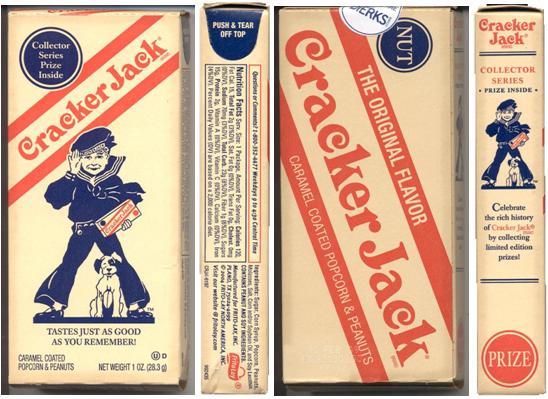
Friday afternoon, my local Aldi store happened to have a huge display of Cracker Jack bags on special for 99 cents each, right in front of the check out lanes. For old times sake, I tossed a bag in my cart. I haven't eaten any in ages, not since I was at least five years old. Part of the whole Cracker Jack experience was the individual box, the feeling of ownership, opening it up like a birthday present and looking for the prize tucked inside. So, I was a bit disappointed that foil bags have replaced the lovely little boxes. As I tore the tear off strip at the top, I wondered if they still included prizes. My heart skipped a beat. Maybe I'd find one of those cute pot metal rings like Paul Varjak so charmingly had engraved at Tiffany's for Holly Golightly? Or maybe one of those teeny plastic hand tools I remember from the 50s?

Sure enough, on the top was one of those familiar paper packets. I ooo-ed with delight and carefully opened the perforated edge. Inside was a tiny booklet with a lame cartoon of two mountain climbers scaling a pencil. The image had two slits and was dubbed a "pencil topper", supposedly to decorate the tip of a pencil. Okay, Frito Lay, I admit it was a huge letdown. But, it tasted even better than I remembered. In fact, it tasted so good, I ate the entire seven ounce bag. Actually, it's only six ounces, since there's at least an ounce of those crumbly lip-sticking kaniggets at the bottom. I nearly fell off my computer chair when I read the nutritional facts on the back of the bag. Serving size: 1/2 cup. Calories: 120. Do you know how many kernels of Cracker Jack fit into 1/2 cup? Six. Who eats just six?
According to legend, a unique popcorn, peanuts and molasses confection, that was the forerunner to Cracker Jack caramel coated popcorn and peanuts, was introduced by F.W. Rueckheim and Brother, at the World's Columbian Exposition, Chicago's first World's Fair. In 1896, Louis Rueckheim, F.W.'s brother and partner, discovered the process for keeping the molasses-covered popcorn morsels from sticking together. Louis gave the treat to a salesman who exclaimed, "That's crackerjack!"

"Crackerjack" was originally a noun, appearing in the U.S. around 1895, meaning "a person of excellence, superior knowledge and ability." The root of "crackerjack" is a sense of "cracker" current in the early 1860s meaning "a remarkable individual" or "an outstanding example of something." This sense of "cracker" was based, in turn, on a very old (around 1460, in fact) sense of "to crack" meaning "to boast or brag." The "jack" element of "crackerjack" doesn't really mean anything. Its role in the word is to rhyme with "crack." (You know how much I adore rhymes and ditties.)

Speaking of ditties, the song "Take Me Out to the Ball Game" written by Jack Norworth and Albert Von Tilzer in 1908, immortalized the snack with the third line, "Buy me some peanuts and Cracker Jack." Since 1918, Sailor Jack and his dog, Bingo, have appeared on the packages. I noticed Jack and Bingo have a new updated 21st century look. In 1964, our Columbus, Ohio based Borden, Inc. purchased the Cracker Jack Company, and in 1997 Borden sold it's division to Frito Lay. The new packaging is okay, but come on; the prize needs a little work.


last two photos borrowed from Google images

Tuesday, May 18, 2010

pink tools of torture


Last week, when I wrote the poem titled Pink, a long legacy of pink hair curlers came to mind. It all started when I was eight, and my hair had finally grown out of that horrid 50s pixie cut, my mother would twist little sections of my wet hair around her finger and clip them in place with two bobbie pins forming an "x". I'll never foget catching the first glimse of myself in the bathroom mirror, in this state of total pin-headedness, brushing my teeth, thinking I looked like some kind of space alien. Was I the only one who made dancing ladies, by threading four bobby pins onto one, then twirling it for her skirt? Okay. Don't answer that.


After the pin-head stage, I graduated to the pink spooly rollers. Speaking of aliens, they were far more fun to play with than wear, since in the closed position, they looked just like pink flying saucers. I remember how they flew in the air and hit me in the face, if I flipped my head around too much.
Next came the pink sponge curlers. Even though they were like stretching my head on the rack, they were a tad more comfortable to sleep in. But for some reason, the one on my right side would invariably fall out during the night, so I would head off to school in a lopsided state. How did those girls manage the perfect flip all the way around?
The spongies were for little girls, so in junior high school, I graduated to the bed of nails pink stubbies, which were covered in prickly spikes, and pink Dippity Doo gel. (Is there some reason why both the gel and all the curlers were pink? No wonder it's not exactly my favorite color.) Some of them had clips and some were held in place with plastic lobotomy-type picks, and were like sleeping every night in an iron maiden. What a price we girls paid for beauty. But, you know, looking back at those old photos, for all the torture, my hair really didn't look that great. I thank God every day for whoever it was who invented the blowdryer. No doubt it was a woman.


photos borrowed from Google images

Wednesday, May 12, 2010

jocko

This afternoon, when I used the name "Jocko" in a piece of poetry, I remembered seeing several lawn jockeys, or Yardells, as they're sometimes called, on our recent road trip through rural Missouri and Kansas. They're fairly rare here in Ohio, but I remember seeing them quite often as a little girl. They were just as popular, or maybe even more so, as garden gnomes.

Historically, a lawn jockey was a black man, dressed in a jockey uniform, holding out one hand, as though taking the reigns of a horse. The hand sometimes carries a lantern, or a metal ring, suitable for hitching a horse. These statues are widely considered racially insensitive and many of the remaining statues have been repainted.

However, some accounts of the figure's origin represent a hero of African American history and culture. According to the River Road African American Museum, the figure originated in commemoration of heroic dedication to duty. It is said that the lawn jockey actually has its roots in the tale of one Jocko Graves, an African-American youth who served with General George Washington at the time he crossed the Delaware River, to carry out his surprise attack on the British forces at Trenton, New Jersey. The General thought him too young to take along on such a serious attack, and left him on the Pennsylvania side to tend to the horses and keep a light on the bank for their return. Jocko, faithful to his post, sadly froze to death during the night, the lantern still in his hand. Washington was so moved by the boy's devotion, he had a statue sculpted and cast of him, holding the lantern, and had it installed at his Mount Vernon estate. He named the sculpture "The Faithful Groomsman".

Dr. Charles Blockson, curator of the Afro-American Collection at Temple University, Philadelphia, claims the figures were used in the days of the Underground Railroad to guide escaping slaves to freedom. "Green ribbons were tied to the arms of the statue to indicated safety; red ribbons meant to keep going...people who don't know the history of the jockey have feelings of humiliation and anger when they see the statue..." Blockson has installed an example of the statue at the entrance to the university's Sullivan Hall.

Monday, January 4, 2010

skeleton leaves & stereoscopes

After my recent post on doppelgängers, in which I included an image
of a stereoview card of Lincoln, my sweet artist friend, Suki, was
kind enough to surprise me with one of my very own! The vintage
stereoview card she sent, pictured below, (click to enlarge) shows a
lacy funerary arrangement of skeleton leaves, in memory of
Abraham Lincoln.

After the death of Queen Victoria's beloved Prince Albert, in 1861,
funeral art became quite an elaborate fashion. Skeleton leaves,
those from which the pulpy part has been removed by chemical
means, and the fibrous part alone remaining, have been an element
of artistic design for years. They're also known as "phantom
flowers", a perfect ingredient to a frilly Victorian death memorial.

I'm sure you've seen these wonderful bits of vintage ephemera, the
stereoview cards, with dual images side by side. They were slipped
in the rear tray of a stereoscope and viewed through an eyepiece,
creating the illusion of depth, similar to the perspectives that both
eyes naturally receive in binocular vision, or 3-D. The stereoscope
was an early version of my beloved little red plastic Viewmaster.
Oh, the hours of complete bliss, clicking away to the magical land of
Sleeping Beauty, and visiting far off places like the Grand Canyon.


Thank you so much, Suki. You know how nutty I am, not only for
Lincoln, but for wonderful vintage ephemera, as well. If you're not
familiar with this talented, red beret clad little lady, pop over to her
artsy blog, Paint, Poems and Ponderings and say hello. Tell her
Willow sent you.
.
photos: skeleton leaves click [here] for source
stereoscope and viewmaster from google images

Thursday, November 5, 2009

Sorbie Castle

My DNA tingling, I couldn't let this week's Theme Thursday subject
"castle" pass, without mentioning Sorbie Castle, my ancestral home.
Although I've never visited, I feel a strong kinship with this place and
it's at the very top of my bucket list. Located one mile east of the
village of Sorbie in Wigtownshire, southwestern Scotland, Sorbie
Castle, or Tower, is a late 16th Century L-plan tower house which
was built for the Hannay family and is now held by the Clan Hanna
Society.
.

The castle was most likely built by Alexander A'Hanna of Sorbie, who
succeeded his father, Patrick, after the latter's murder in 1543. At
the time the castle was built, the A'Hannas were at the height of
power, as Lords of the Manor. Their land stretched across the
Machars of Galloway, to such an extent, that it was known as
Machars Hannay. It certainly appears that the Hannay and Sorbie
family histories are intertwined. The big question is whether the
Sorbies were a family in their own right, with their own distinct
history, or an offshoot of the Hannay or some other family, who took
the name Sorbie to denote their place of origin.
.
In its day, Sorbie Castle was a structure of considerable importance
and may have actually been preceded by an earlier wooden castle,
since there is a nearby mound, which MacGibbon and Ross mention
in their work, The Castellated and Domestic Architecture of
Scotland. In 1993, the Archaeological Department of Glasgow
University carried out a dig on the mound, finding shards of pottery,
identified as coming from Bordeau around 1250. They also found
pieces of coins of Henry III of France and traces of the base of a
flying bridge, like appear in the Bayeux tapestry.

For more photos of Sorbie Castle, click on a tour by Scott Hanna.
[HERE] Although, I've not met Scott personally, he is a fellow Hanna
descendant.

Looking east from Sorbie Village.

Map showing Sorbie Village, including Sorbie Tower, center


This just in...

FireLight just pointed out how much Sorbie Castle looks like the
ruins of Moy Castle, pictured below, used in the filming of one of
my favorite movies of all time, Powell and Pressburger's 1945
film, I Know Where I'm Going. She is so right. I've gotta watch it
tonight. Now, where'd I put those woolly socks?

Moy Castle

Sunday, November 1, 2009

steles


stele: also ste·la (stē'lə) pl. steles also ste·lae (-lē) An upright stone marker or slab with an inscribed or sculptured surface, used as a monument or as a
commemorative tablet in the face of a building.


Every year, I like to take at least one lovely autumnal walk through a cemetery. I enjoy the history, as well as all the various forms of funerary art. There is something very compelling, full of human truths, that draws me to these places of solace and beauty.

Tombstones were relatively simple, like the one of my fifth great grandfather, below, who was a captain in the American Revolution, until Queen Victoria, who after the death of her beloved Albert, in1861, went on a veritable mourning frenzy and led the way in making memorialization fashionable. Cemeteries were not only a pleasant respite from the dirty and noisy cities; they also became large scale public art galleries.

The words carved on Captain Robert "Robin" Hanna's stone are these:

He was a brave defender of his country's rights
and lived and died an honest man.
On one of my last visits to my dear grandfather, who passed away two years ago, at the ripe old age of 93, he took me out to some old rural Indiana cemeteries to locate the stones of our ancestors. It was a beautiful October afternoon and I don't know who enjoyed the day more, he or I.

This month, on my walk through the Oak Grove Cemetery and Arboretum in Delaware, Ohio, this stone, "Pompey King, died Apr. 8, 1844, aged 100 years", caught my eye. I was curious what information I might find on Pompey, so on my return home, I promptly did a bit of research. I found him listed on the Official
Roster of the Sons of the American Revolution Buried in Ohio. He was married September 23, 1815 to Sally Stonemia in Licking County, Ohio. I wonder what he would think about me blogging about him, some 165 years after his death? I wish I knew the origin of his unique name. What was his secret to longevity?

(for ore info o Pompey King,see addendem at the end of this post)
The image on the stone below is full of symbolism. A winged Death, complete with sickle, much like the one pictured in my header, is accompanied by an angel of grief (sorrow), holding an olive branch (peace), and a broken column (early death).

Listed below are other intriguing symbols often depicted in tombstone art. Ivy or a lamp would be beautifully symbolic. I don't know about you, but I don't think I'd like a gourd or skeleton on my stone. Hmm. Maybe a lovely willow tree would be more appropriate?

Anchor - Steadfast hope
Angel of grief - Sorrow
Arch - Rejoined with partner in Heaven
Birds - The soul
Book - Faith, wisdom
Cherub - Divine wisdom or justice
Column - Noble life
Broken column - Early death
Conch shell - Wisdom
Cross, Anchor and Bible - Trials, victory and reward
Crown - Reward and glory
Dolphin - Salvation, bearer of souls to Heaven
Dove - Purity, love and Holy Spirit
Evergreen - Eternal life
Garland - Victory over death
Gourds - Deliverance from grief
Hands - A relation or partnership
Heart - Devotion
Horseshoe - Protection against evil
Hourglass - Time and its swift flight
Ivy - Faithfulness, memory, and undying friendship
Lamb - Innocence
Lamp - Immortality
Laurel - Victory, fame
Lily - Purity and resurrection
Lion - Strength, resurrection
Mermaid - Dualism of Christ
Oak - Strength
Olive branch - Forgiveness, and peace
Palms - Martyrdom, or victory over death
Peacock - Eternal life
Pillow - Deathbed, eternal sleep
Poppy - Eternal sleep
Rooster - Awakening, courage and vigilance
Shell - Birth and resurrection
Star of David - God
Skeleton - Life's brevity
Snake in a circle - Eternal life
Swallow - Motherhood
Broken sword - Life cut short
Crossed swords - Life lost in battle
Torch - Eternal life if upturned, death if extinguished
Tree trunk - Beauty of life
Triangle - Truth, equality and the trinity
Shattered urn - Old age, mourning if draped
Weeping willow - Mourning, grief


This just in...After Roy mentioned in his comment that he thought Pompey King might have been a slave, since they were often named classical names as such, I did a bit more research, and found that Pompey
King was indeed an African American, former slave and pioneer! Serving in the American Revolution was mostly likely his ticket to freedom. He was also listed a member of the First Presbyterian Church. First buried in the Old Burial Ground, his body was later moved to the Oak Grove Cemetery, in Delaware, Ohio. For more Ohio historical info from the Ohio Digital Resource Commons at Ohio Wesleyan University, visit [HERE].

Isn't it curious, that Pompey King and my Capt. Hanna were born the same year and both served our country in the revolution. I wonder if they possibly could have known each other?

Thanks, Roy. This aspect of the blogging community is one of the things I like best. ~x

Tuesday, October 6, 2009

pencil me in

Hey, I hope you are getting your dance cards ready for next week's
big event, here at the manor. Did you know that the dance card,
also known by its German name, Ballspende, or plural Ballspenden,
is used to record the names of those with whom are intended to
dance each successive dance at a formal ball? They appear to have
originated in 18th century, but their use first became widespread in
19th century Vienna.

An actual dance card is typically a booklet with a decorative cover,
listing dance titles, composers, and the person with whom a woman
intended to dance. Typically, it would have a cover indicating the
sponsoring organization of the ball and a decorative cord by which it
could be attached to her wrist or ball gown. From the 19th century
until World War I, dance cards for the elite of Austria-Hungary were
often very elaborate, with some even incorporating precious metal
and jewels.

In modern times the expression "dance card" is often used
metaphorically, as when someone says "pencil me into your dance
card", meaning "find some time to spend with me". When someone's
"dance card is full" it implies they have no time for, or interest in
another person. So, please do pencil me into your bloggy dance
cards for next Tuesday, October 13th. Be there or be square!

info from Wikipedia and photos from google images

Tuesday, September 29, 2009

days of heaven

I noticed this past weekend, as we drove by fields of corn and
soybeans, most had not yet been harvested. There were a few
freshly cut alfalfa fields and the contrasting tall golden corn was so
lovely. Even though I am a city girl, my roots are firmly planted in
the farmlands of the Midwest, and I enjoy basking in their simple
beauty.

The Netflix film, waiting in my mailbox on our return, was Terrence
Malick's Days of Heaven. Synchronicity came into play with my
thoughts of farmland and harvest. I was previously unaware of this
film's theme and had ordered it by suggestion of Netflix; you know,
the "if you liked this movie, you'll will like this one" kind of thing.

As it turned out, this was one of the most stunningly beautiful films
I've ever seen. It's a story about a young man (Richard Geer) who
flees Chicago in the early 1900s after an accidental murder in a steel
mill. He takes his girlfriend (Brooke Adams) and his younger sister
(Linda Manz, pictured above) to work harvesting wheat in Texas.
The photographic genius of cinematographer, Néstor Almendros, who
won an Oscar for his work, and the endearing narration of the story,
by the raspy voiced young Manz, makes for an extraordinary
experience. Doesn't she look like she could be the girl on the left, in
thrashing photo below?

I descend from five generations of Indiana farmers and my DNA was
particularly tingling as I watched this movie. My grandfather
(pictured below, on a thrasher) told me stories of he and his brother
working with teams of thrashers, like this one pictured above, in
Ervin Township, Howard County, Indiana. It was very much a
community affair; the men and the traction engine were rotated
through the farms until all the harvest was in, and the woman would
get together and cook generous hot meals for the workers.

The scene from the movie below, of the dispensing of a blessing on
the field of wheat, before the harvest begins, is especially touching.
Now is the perfect season for watching this gorgeous movie, and
almost time to get out the woolly socks, too. So, do yourself a favor,
and add this film to your queue. It was so heavenly, I'm watching it
again tonight.
.

top photo: Flax worker near Yeovil, First World War, by Horace Nicholls

Saturday, September 12, 2009

Scots in Yellow?


Since I am all about tartans this week at the manor, this little bit
of tartan trivia caught my eye. Sorry, Mel. As much as I loved the
hunky kilt clad clansmen in the movie, (the mullet did drive me a
little nuts, though) it seems the medieval Bravehearts of Sturling
Bridge and Bannockburn did not actually wear tartan kilts in battle,
like the one pictured below, designed especially for the film.


Historian Fergus Cannan in his new book, Scottish Arms and Armor,
claims the clansmen actually wore bright yellow linen tunics into
battle. Apparently, the tunics were dyed with horse urine (sorry if
you're trying to enjoy your morning Cheerios) to achieve the rich color.
I'm sure this lovely aroma also helped to repel the English, who as we
know from Monty Python, smelled like elderberries.

Tuesday, July 21, 2009

Knock on Wood


WT recently informed me that in Bulgaria, when someone says "knock on wood", they actually knock underneath the table, in order to hide it from the fates, or powers that be. I was fascinated by this little twist on the theme and had to find out more about this familiar expression.

Knocking on wood, and the spoken phrase "knock on wood" or "touch wood" are used to express a desire to avoid tempting fate after making some boast or speaking of one's own death. The expression is usually used in the hope that a good thing will continue to occur after it has been acknowledged. So, for example, one might say: "The rain looks like it's holding off, touch wood", or "Knock on wood, I'm feeling much better now."

It is commonly thought that knocking on wood has been a superstitious action to ward off evil throughout history involving Pagan belief systems. The same reference claims that knocking on wood is also used in some form of Christianity, but in a different context, where the wood represents the cross. In an alternate explanation, the wood represents the rosary. "Lord willing" is also a common expression in Christian circles, with a similar intent.

Another explanation for this practice is the pagan belief that spirits or dryads lived in trees. By knocking on the wood of a tree while making some sort of a bold statement, the speaker could prevent the spirit from hearing them and stop the spirit from interfering. Or out of respect for the wood spirit, touching a tree indicated seeking protection from the particular spirit. Hmm. I wonder if Keebler got their marketing idea from this?

Some historians believe the saying cannot be traced beyond children's games of tag of the early nineteenth century. They maintain the earliest documented references to "touching wood" are
from 1805 and 1828 and concern chasing games where you are safe from being "tagged" if you "touch wood". "'Tiggy-touch-wood" was an extremely well-known game, and it is more than likely that the phrase was passed into everyday language. Funny, we as kids, over one hundred years later, still always chose a tree as "base".

Here are some interesting international variations:

Denmark: "bank under bordet" (knock under the table).

Germany: the version "auf Holz klopfen" (knock on wood) can be accompanied by the phrase "Toi, toi, toi" (probably derived from the Old German word for 'Devil') which is still used as a charm to ward off evil or as a good luck charm for thespians out of superstition that wishing an actor good luck brings the opposite. I'm familiar with this one from the opera world.

Italy: a similar superstition exists, it's said "Toccare ferro" and the meaning is similar: one must touch metal, preferably iron.

Norway: the term "bank i bordet" ("knock the table" or rather: "knock the wooden board" ('bordet' is an ambiguity)), is used. In Norway, it is also sometimes used to stress that you're telling the truth (akin to saying "I swear to god that...").

Sweden: the phrase "ta i trä" (touch wood) is commonly used as a part of the phrase "peppar peppar, ta i trä" (pepper pepper, touch wood), the double "pepper" also being used to ward off a temptation of fate. It's often shortened to just saying "peppar peppar" while knocking on wood.

Turkey: "tahtaya vur" (knock on wood) is used. Usually, someone else will answer: "Şeytan kulağına kurşun" (May somebody melt some lead into Satan's ear).

India: it's said as "Nazar Na Lage" (let there be no evil eye), in Hindi and the meaning is similar; it is used, when something seems too good. It's like saying "touch wood", "Kannu pada
Pooguthu" (let there be no evil eye), in Tamil.

And of course, this post would not be complete without my favorite "knock on wood" song! Now, who's lucky?